My PR gate is now a stream of events: /ship meets Claude Code's Monitor tool
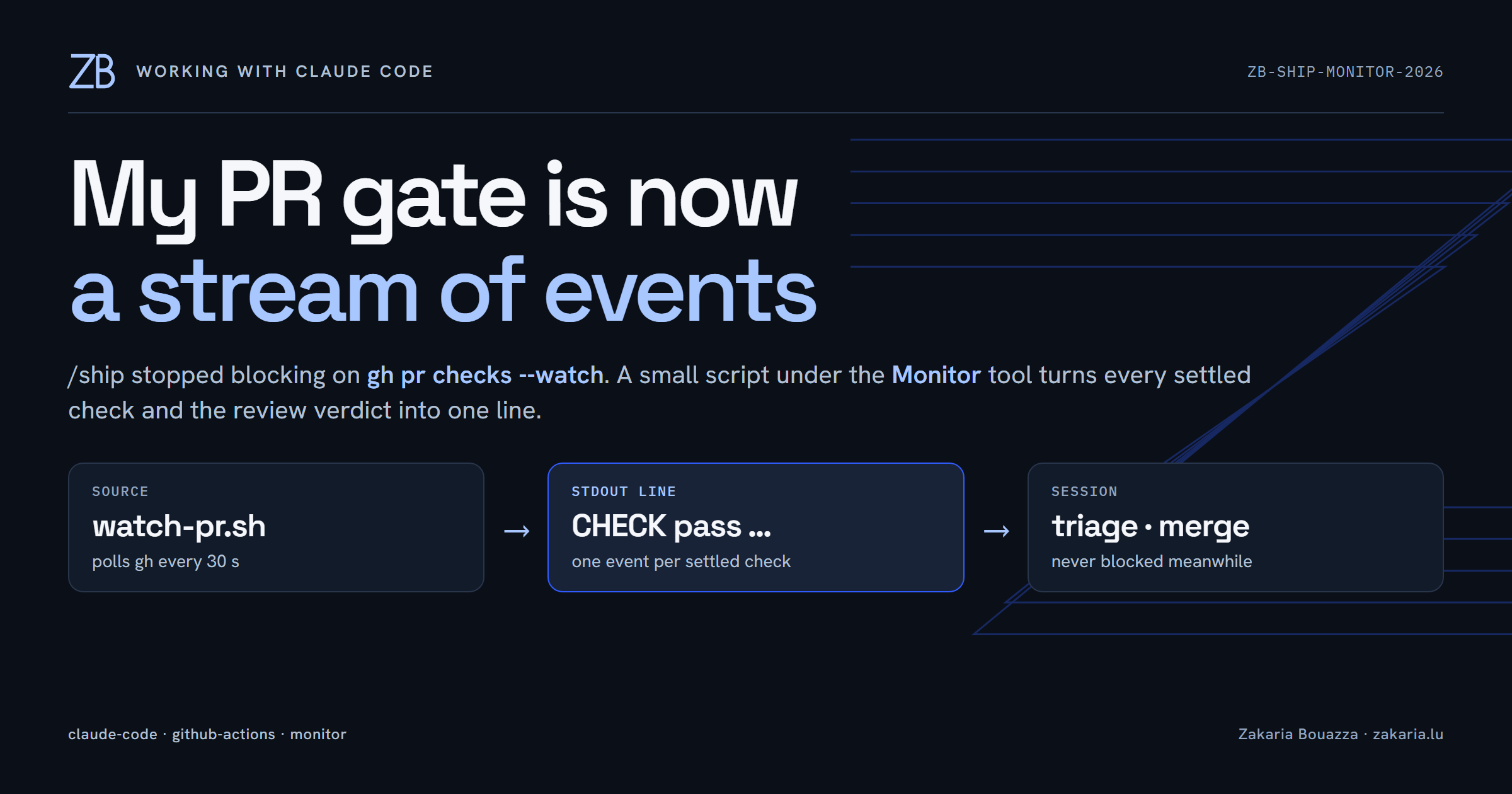
A few days ago I watched a 36 GB model download with Claude Code's Monitor tool. The idea that stuck with me was simple: every stdout line of a background script becomes an event in the conversation, and the session keeps working while they arrive. Today I applied the same idea to something I run far more often than a download: the merge gate in my /ship skill.
The step that blocked
/ship is the skill Claude Code follows to take a change on this site from working tree to production: tracking issue, branch, commit, PR, CI plus an independent Claude review, merge, deploy, live check. Step 5.5 is the gate. Two workflows run on every PR, ci.yml and claude-review.yml, and on GitHub's free plan neither can be a required check, so the skill itself is what stops a red merge.
Until today that step said: run gh pr checks <#> --watch until everything finishes, then run gh pr view --json comments, find the newest comment that starts with <!-- claude-review, and compare its sha= with the PR's head so a stale verdict doesn't count. It worked. But the watch is a blocking command that says nothing until the end, and the "is this verdict for the current head?" logic lived in prose that the model had to re-execute correctly every time.
One script, one line per event
The replacement is .claude/skills/ship/scripts/watch-pr.sh. It polls GitHub every 30 seconds and prints only what changed. The core is a diff between the checks that had settled on the previous poll and the ones that have settled now:
json=$(gh pr checks "$pr" --json name,bucket,link 2>/dev/null)
# exit 8 = still pending, 1 = no checks yet: read the JSON, ignore the code

settled=$(jq -r '.[] | select(.bucket != "pending")
  | "CHECK \(.bucket) \(.name) \(.link)"' <<<"$json" | sort)
comm -13 <(printf '%s\n' "$prev" | sed '/^$/d') \
         <(printf '%s\n' "$settled" | sed '/^$/d')   # only the new ones
prev=$settled
comm -13 prints lines that appear only in its second input, so a check is announced once, when it settles, never on every poll. When nothing is pending any more, the script looks up the review verdict for the current head, prints it, prints DONE and exits. The skill now tells Claude to arm it like this:
Monitor({
  command: "bash .claude/skills/ship/scripts/watch-pr.sh 524",
  description: "PR #524 CI + Claude review",
  timeout_ms: 1800000
})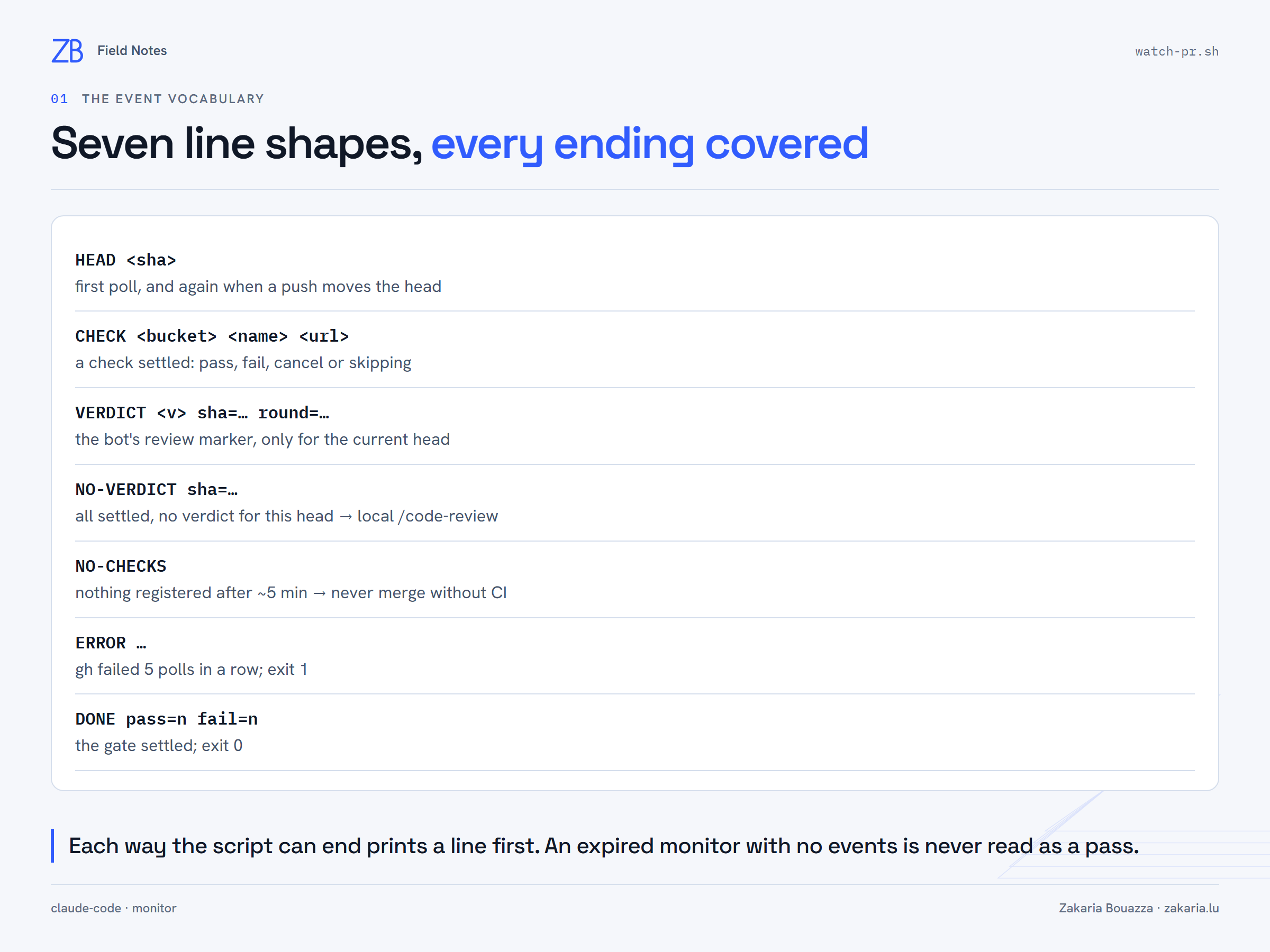
The whole protocol between the script and the session is seven line shapes. Every way the script can end prints one of them first.
Silence is not success
The lesson I carried over from the download post is that a watch which only reports good news looks exactly like a dead one. So I wrote the failure lines first. If no check has registered after about five minutes, it prints NO-CHECKS, and the skill says never to merge without CI. If gh fails five polls in a row (auth expired, network gone), it prints ERROR and exits 1 instead of quietly looping until the Monitor's 30-minute cap. If every check settles but there is no review comment for this head, it prints NO-VERDICT, which triggers the fallback: a local /code-review.
Two smaller details matter. gh pr checks exits with 8 while checks are pending and 1 when none exist yet, so the script ignores the exit code and validates the JSON with jq instead. And the script holds no state between runs: if the monitor expires, Claude re-arms it and the settled checks are printed again. That is redundant, but it means a lost event can never hide a red check.
What it looks like from my side
This is the part I like most. While the PR runs, Claude Code's task panel shows the monitor with each event as it lands:
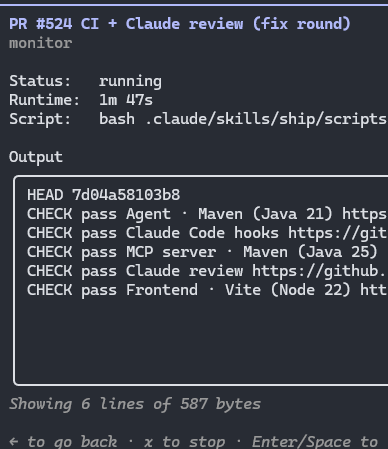
The fix-round monitor on PR #524, 1 minute 47 seconds in: five checks green, the backend build still running.
In the conversation each line arrives as a notification. Claude acknowledges it in a sentence and waits for the next one, and I can ask it something else in the meantime. When DONE lands, it reads the verdict and moves on to triage or merge.
The watcher shipped itself, and the review caught it
The first live run was the PR that introduced the script. I ran /ship on it, and the new step 5.5 watched its own checks. Round 1: all six checks green, verdict FINDINGS. The CI review had found a real hole. My verdict_for function took the newest marker comment from any author, while the workflow itself only trusts comments from github-actions[bot], for exactly this reason. Anyone who can comment on the PR could have posted <!-- claude-review sha=<head> verdict=CLEAN -->, and the script would have reported a clean gate.
The fix is one more condition in the jq filter. One detail would have tripped me: gh pr view reports the bot as github-actions, while the REST API says github-actions[bot]. I checked against the real comment before writing it:
[.comments[]
  | select(.author.login == "github-actions"
           and (.body | startswith("<!-- claude-review ")))
  | .body | split("\n")[0]] | last // ""
A negative test with a fabricated comment from another user confirmed the forged CLEAN is ignored. Claude pushed the fix and armed a fresh monitor, which printed the new HEAD, and round 2 came back CLEAN with six green checks. The skill allows exactly one fix round on its own, so that was the end of it.
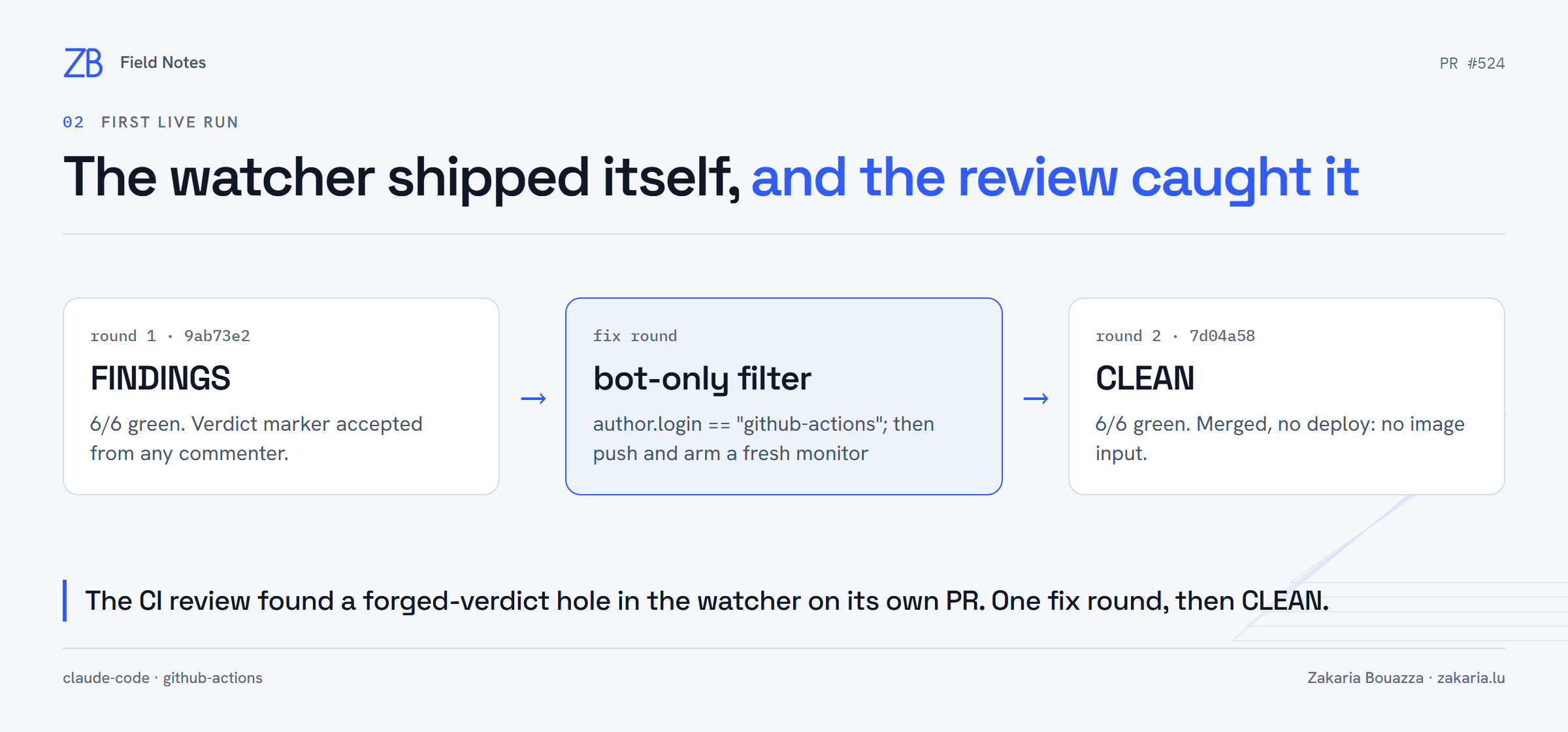
PR #524 end to end: the independent review found a forged-verdict hole in the watcher, on the watcher's own PR.
Two gotchas on the way
CRLF. With
core.autocrlf=true, Git warned it would check the script out with CRLF line endings, and bash chokes on the trailing . The repo had no.gitattributes; it now has one line,*.sh text eol=lf.The master guard looks at HEAD before the command runs. A single Bash call doing
git checkout -b … && git commitis still blocked, because the hook evaluates the branch before any of it executes. Branch in one call, commit in the next.
Why I prefer this shape
The merge gate used to be a set of instructions the model had to re-run correctly every time. Now the deterministic part (which checks settled, whether the verdict matches the head, whether the author is the bot) lives in a script I can test against old PRs, and the model only reacts to a small, closed set of lines. It is the split I would want in any event-driven system: producers emit facts, the consumer decides. And the fact that a fresh-context reviewer caught a trust bug in the very first version is the best argument I have for keeping that review in the loop.