My honest take about vibe coders
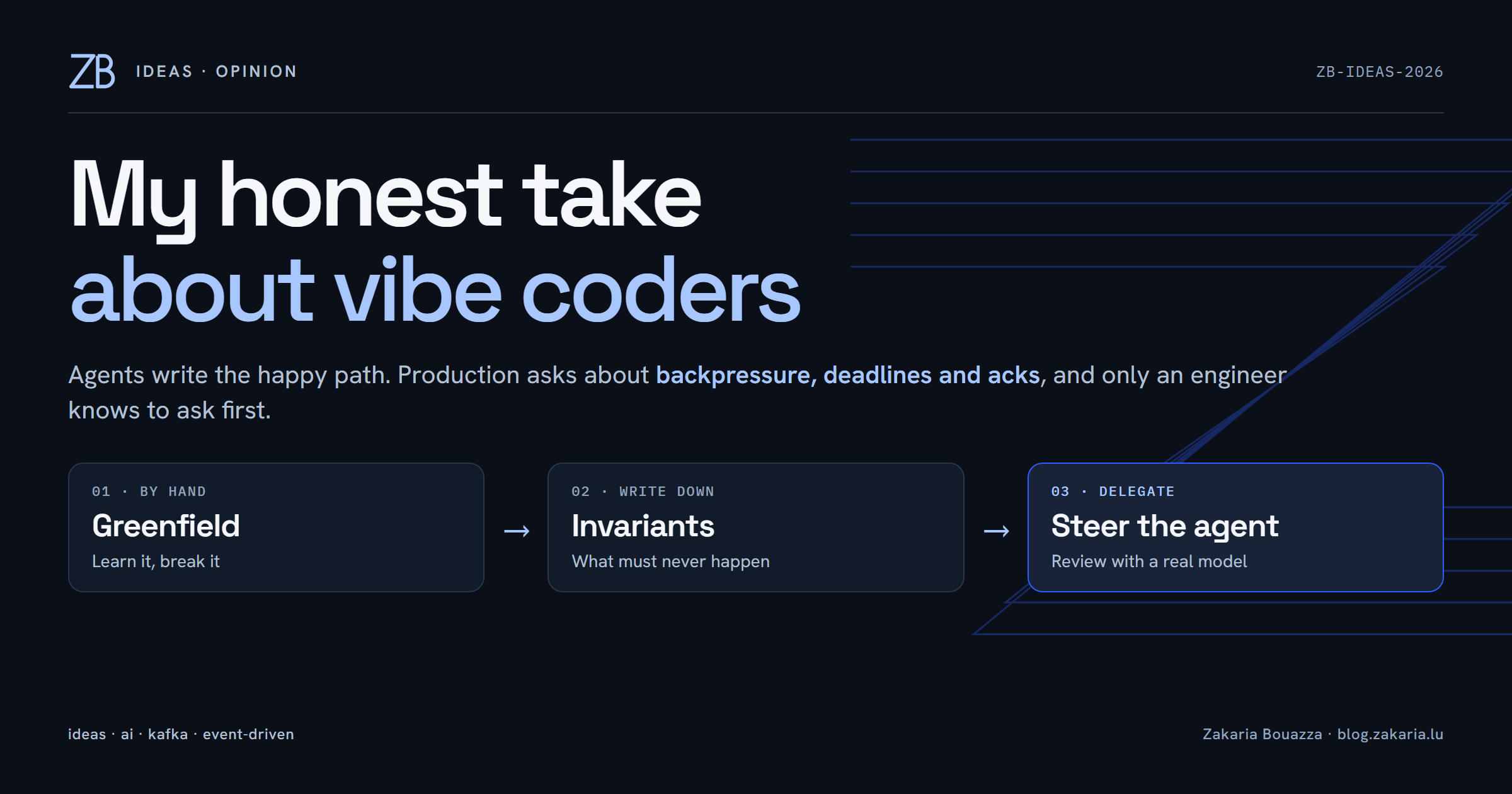
I'll be blunt: the "anyone can ship software now" story bothers me. Not because I think non-engineers shouldn't build things, but because I know what happens to a system after the demo. If you have never worked on a well-architected project, you don't know which questions production is going to ask you. And production always asks.
This is an opinion piece, so let me be clear about where I stand. I use AI agents every day. Claude Code writes a large part of the code on this site. I'm not against the tools. I'm against the idea that the tools replace the judgment.
The happy path is the easy part
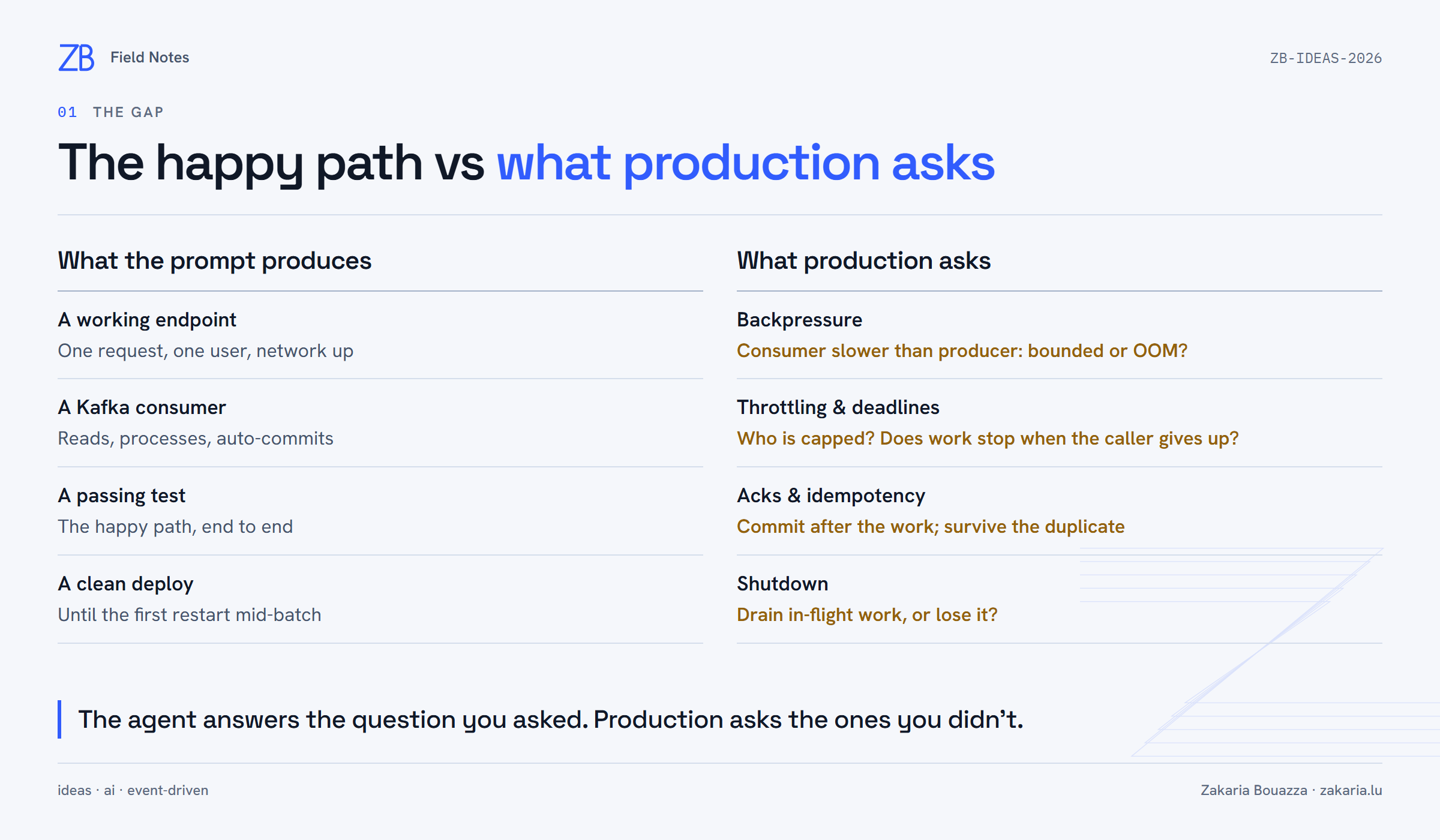
An agent will give you a working feature in minutes. It compiles, the tests pass, the page renders. What it gives you, unless you ask, is the happy path: one request, one user, the network up, the database fast, the consumer keeping pace with the producer.
Production is everything else. The questions that matter are the ones you can't see in a UI:
- Backpressure. What happens when the consumer is slower than the producer? Do you have a bounded queue, or does memory grow until the pod is killed?
- Throttling. What stops one noisy client, or one crawler, from eating your whole capacity or flooding your inbox?
- Deadline propagation. If the caller gave up after two seconds, why is the third service downstream still working on that request for thirty?
- Acknowledgments. When exactly do you tell Kafka a message is done: before or after the work is committed?
- Idempotency. At-least-once delivery means duplicates. What happens when the same event arrives twice?
- Shutdown. When the container stops during a deploy, does in-flight work drain, or does it just vanish?
A non-engineer doesn't know these are questions. That's the real gap. It isn't syntax, and it isn't speed.
A concrete example: Kafka acknowledgments
I work with Kafka in banking, and the acknowledgment question is a good test. A common mistake is to hand records to a thread pool and let the consumer's auto-commit carry on. The offsets advance on the poll interval, not when the work finishes. If the process dies mid-batch, those messages are gone. Nothing fails loudly. You find out weeks later, from a reconciliation report.
The fix isn't exotic. You commit after the work, and you make the work safe to repeat:
// Container factory configured with AckMode.MANUAL_IMMEDIATE
@KafkaListener(topics = "payments", containerFactory = "manualAckFactory")
void onPayment(ConsumerRecord<String, PaymentEvent> rec, Acknowledgment ack) {
    PaymentEvent event = rec.value();
    if (processedEvents.alreadySeen(event.eventId())) {   // duplicate from a redelivery
        ack.acknowledge();
        return;
    }
    paymentService.apply(event);                           // throws → no ack → retry / DLT
    processedEvents.mark(event.eventId());                 // ideally in the same DB transaction
    ack.acknowledge();
}
An agent will write exactly this if you ask for "manual acks, idempotent on event ID, dead-letter after three attempts". It will rarely choose it if you ask for "a consumer for payment events". The knowledge isn't in the typing. It's in knowing that the sentence needs to be written.
Event-driven systems are where this bites hardest
I built an event-driven system with Spring Integration, and what I learned there wasn't the DSL. It was the vocabulary of failure: channels with a capacity, pollers that take a bounded number of messages per cycle, error channels so a poison message is routed instead of retried forever. Those are design decisions about load and failure, not about features.
The same thinking shows up in this site, which is a small app. The notification outbox delivers at least once, with a capped number of retries and recovery for rows stuck in processing. Its wire protocol is frozen so that a rollback to the previous runtime can still drain pending rows. The instant mail for anonymous visits is deliberately not on the outbox, and it is throttled in memory so a crawler can't flood my inbox. In production, Guice builds every singleton before the database migrations run, so no constructor may touch the database. None of these rules came from a prompt. Each one came from knowing what goes wrong.
How I actually work: greenfield first, then the agent
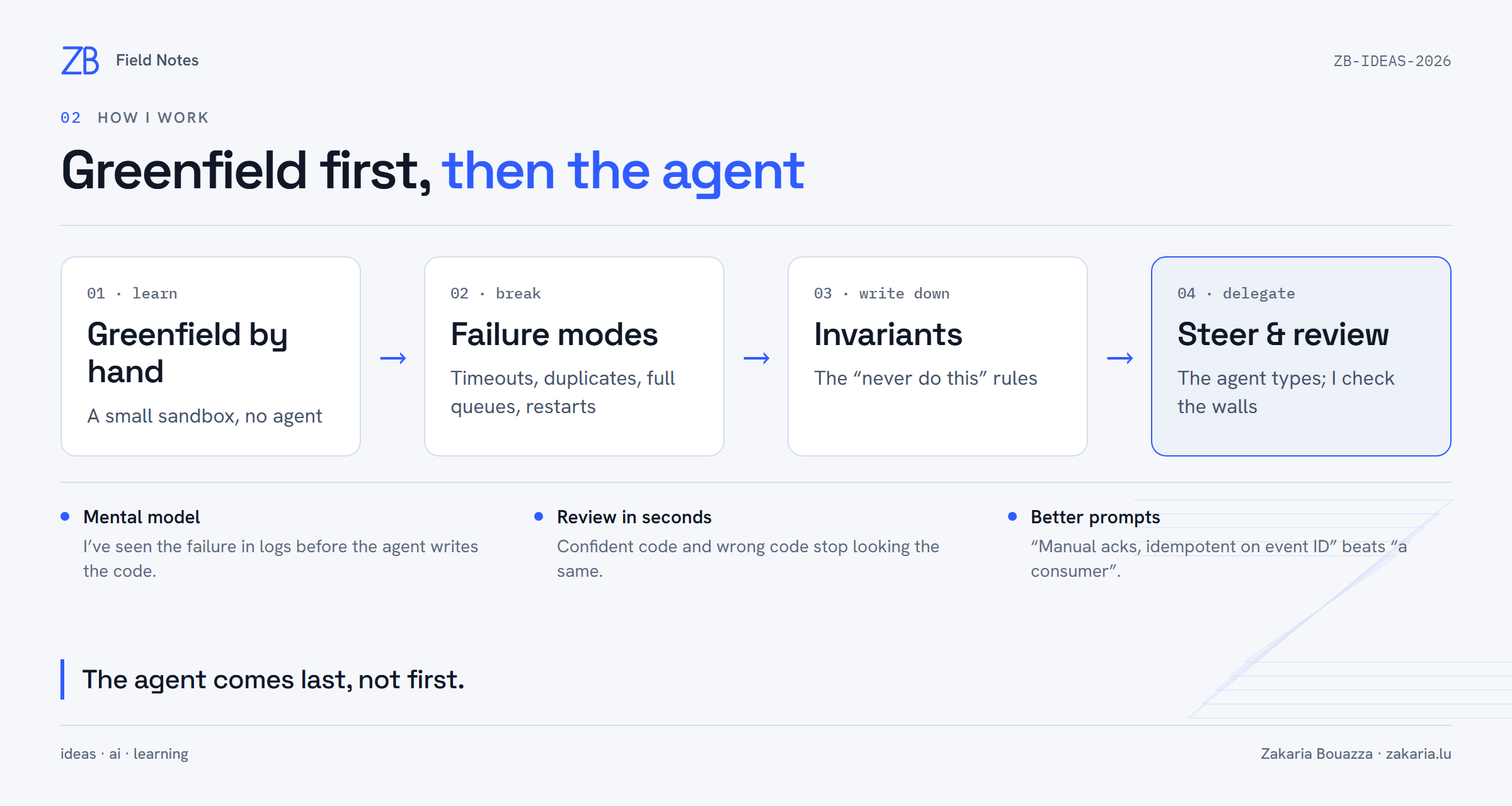
Here is the habit I think matters most. Before I let an AI drive in a system or a technology, I learn it myself, in a greenfield project. A small sandbox, written by hand, where I break things on purpose. That's why some of my blog series exist: I worked through MongoDB, enumeratum and the design patterns as small runnable projects before I relied on them anywhere else.
The greenfield step gives me three things an agent can't give me:
- A mental model of the failure modes. I've seen the timeout, the duplicate, the full queue. I know what they look like in logs.
- The ability to review. When the agent writes a consumer, I can tell in ten seconds whether the commit happens in the right place. Without the greenfield work, its confident code and its wrong code look the same.
- The right invariants to write down. The rules in this repo's instructions, the ones that say "never do this", only exist because I understood the system first.
After that, I delegate a lot. The agent is a fast pair of hands. But I know where the load-bearing walls are, and it doesn't.
Where I'd push back on myself
I don't think this is as simple as "engineers good, vibe coders bad".
First, the patterns aren't secret anymore. An agent can implement backpressure or deadline propagation correctly when asked. The bottleneck has moved from writing the pattern to knowing it's needed and verifying it was done right. That's still engineering, but the skill mix is different: more specifying, more reviewing, more testing of failure paths.
Second, some vibe coders will become engineers the hard way. Data loss in production is a very effective teacher.
Third, and this is what worries me most: the real risk isn't non-engineers building small apps. It's junior engineers who never build the scar tissue, because the agent always got them to green. If you never learn the system by hand, you never get the model you need to steer.
Engineers will be in demand
So my honest take: engineers who can steer agents will be in high demand, more than before. Steering means writing down the invariants, rejecting plausible-looking wrong code, and asking "what happens when this times out halfway?" before production asks it for you.
If you want to use AI well, my advice is boring. Pick the technology, build something small with it by hand, break it, and only then let the agent drive. The agent is fast. Speed in the wrong direction just gets you to the incident sooner.