Jev and the case for a decision layer in AI systems
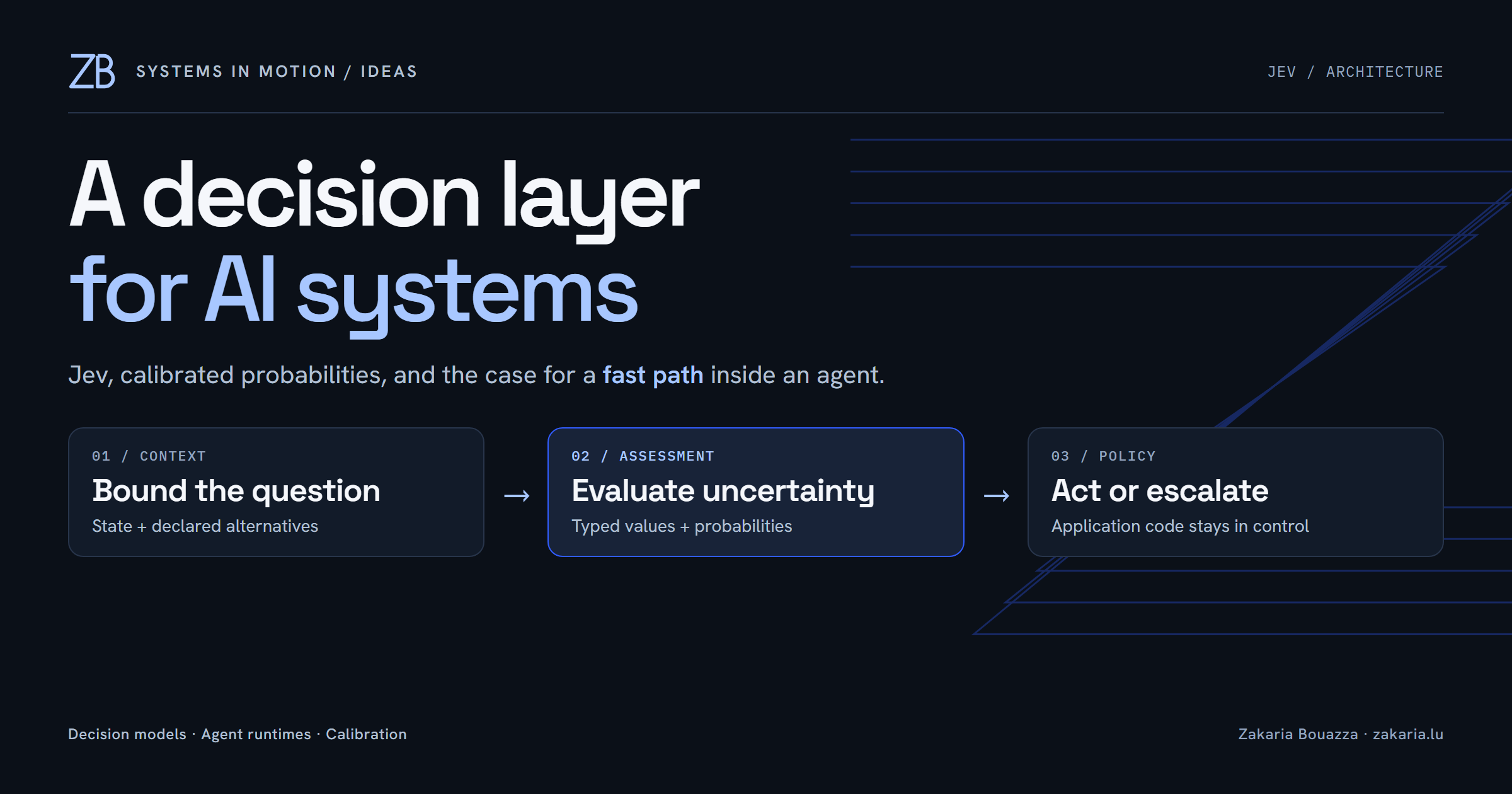
Why are we using a text generator to make every decision?
An agent needs to choose a tool. A support service needs to route a request. A workflow needs to decide whether it has enough information to continue. Often, we hand all of that to the same generative model that writes the final answer.
Sometimes that is justified. Sometimes we are asking a very capable text generator to behave like an expensive conditional statement.
Jev caught my attention because it exposes a different interface: give a model context and bounded questions, then consume typed answers and probabilities. As a backend engineer, I want to explore what that interface could do for an application's architecture.
Research snapshot: 17 September 2026. This is an analysis of public documentation, research and reported experiments. I have not benchmarked Jev myself. The runtime design below is a proposal.
What Jev is, and what is actually established
TypeSafe AI introduced Jev in a launch post dated 15 September 2026, with access offered through a waitlist. Founder Diogo Almeida calls its category System One Models: models intended for fast, structured judgments consumed by software. The company describes a new architecture, a parallel sampler and a training method called RLCD. Those are TypeSafe's descriptions of its system, not an independently reproduced account of its internals. TypeSafe's launch post.
Almeida is a coauthor of the 2022 InstructGPT paper. That is a directly checkable research contribution; it is more precise than reducing the history of ChatGPT to a single inventor. TypeSafe's team page also lists cofounders Sasha Sheng and Erik Gafni. InstructGPT paper; TypeSafe team.
I keep four kinds of evidence separate here:
- Established concepts: autoregressive generation, classification, calibration and model cascades predate Jev.
- Publicly inspectable contracts: TypeSafe documents an API, SDKs and typed response shapes. Documentation establishes the advertised interface; it does not prove its accuracy.
- Vendor claims: Jev's calibration, comparative capability and performance need evaluation beyond the company's own results.
- Architectural interpretation: my proposed agent control plane follows from that interface. It is not evidence of a deployment I have built.
A decision does not always need to become a sentence
A conventional autoregressive transformer processes the input and generates a continuation, each new token conditioned on the preceding context. A tool call can be that continuation just as easily as prose. Longer outputs add decoding work; reasoning can add further generated tokens. Input processing, network transit, batching and serving also contribute to latency. Hugging Face's generation documentation.
That is a useful capability when I need an explanation, a program or a plan. When I need one route from a known list, producing a sequence may be unnecessary work.
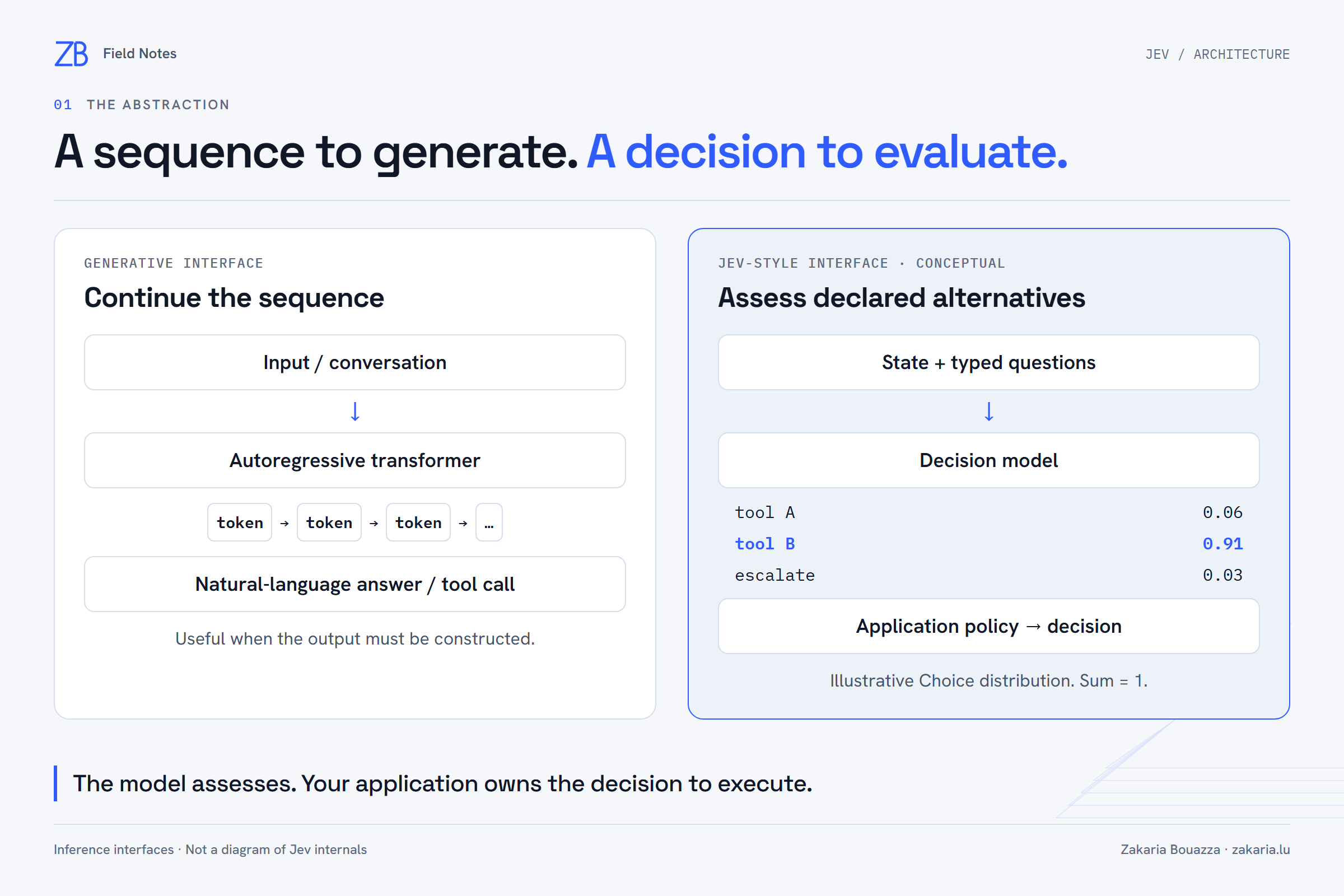
Generative LLMs already support structured outputs, and a classifier need not produce prose. TypeSafe even publishes an adapter that implements its decision interface using LLM APIs, including native structured-output modes. The interesting proposition is the combination of a bounded interface, useful probability estimates and a cheaper execution path—not the invention of enums or classification. TypeSafe's System One adapter.
Typed questions are an application contract
The documented interface has three primitives:
| Primitive | Question shape | Documented result |
|---|---|---|
| Choice | Which declared alternative fits? | Selected alternative, probabilities over alternatives, confidence. |
| Score | Where does this sit on a defined rubric? | Numeric score, distribution over ordered levels, confidence. |
| Noul | Is this statement true? | A probability of yes, between 0 and 1. |
Choice supports up to 255 alternatives. Score can fall between rubric levels. Noul is TypeSafe's name for its binary probability primitive; it has no separate confidence field. Choice, Score, Noul.
For a single question, “Which handler should run next?”, an illustrative distribution might be:
search_web       0.04
query_database   0.91
ask_user         0.03
delegate_to_llm  0.02
                 ----
                 1.00
These alternatives represent one choice, so their probabilities sum to 1. They estimate which route fits the question; they are not automatically estimates of each tool's execution success.
The values 0.08, 0.91, 0.03, 0.14 would make sense for four separately evaluated yes/no statements about whether each action is useful. Several could be useful together, so that set need not sum to 1. Separate evaluation also does not establish statistical independence between those events.
That distinction matters when writing the contract. “Choose one next action” and “evaluate these four possible actions” are different tasks.
Here is an illustrative request body using the documented HTTP contract, not a recorded API call:
{
  "model": "jev-1.13.0",
  "state": {
    "request": "Where is order A-104?",
    "available_tools": ["order_lookup", "policy_search"],
    "known_order_id": "A-104"
  },
  "questions": {
    "route": {
      "type": "choice",
      "instructions": "Which handler should run next?",
      "criteria": {
        "query_database": "Read an identified order's current status",
        "retrieve_policy": "Find an explanation of store policy",
        "ask_user": "Request missing information",
        "delegate_to_llm": "Handle a request requiring further reasoning",
        "other": "None of these handlers fits"
      }
    }
  }
}
It goes to POST https://api.typesafe.ai/v1/systemone, using bearer authentication. Requests contain state, model and questions; answers return under the supplied question keys. Those keys are identifiers and are not shown to the model. Put meaning in the instructions and criteria. HTTP API reference.
State can be text or structured JSON. TypeSafe documents evaluating multiple questions separately against the same state in one call. If question B needs the result of a tool chosen by question A, that result does not exist yet: execute the tool and submit updated state in a later step. State semantics.
Calibration gives the number a meaning
A probability is useful only if its relationship to outcomes is understood.
Suppose a model assigns roughly 0.8 probability to a predicted class across many comparable cases. If it is well calibrated for those cases, approximately 80% should ultimately be correct. The remaining 20% are compatible with good calibration. It is a property measured over predictions, not a guarantee about the next one. Calibration is established ML territory; Guo and colleagues studied it in modern neural networks in 2017. On Calibration of Modern Neural Networks.
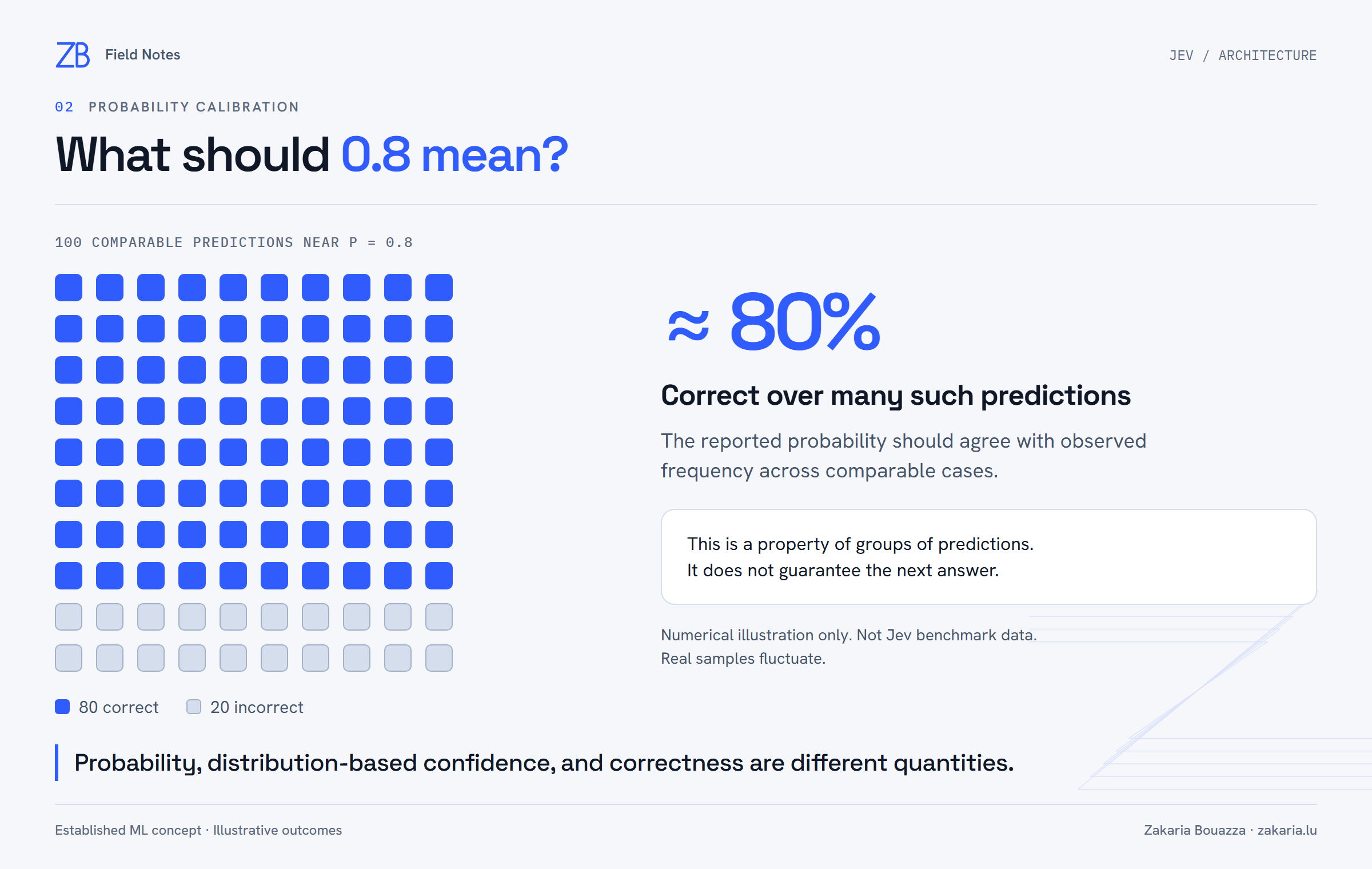
Calibration and discrimination are different. A predictor that always reports a population's base rate can be calibrated while doing little to distinguish individual cases. I need both useful decisions and probabilities that match observed outcomes.
There is also an API detail worth preserving: TypeSafe's confidence is a statistic derived from how concentrated the returned distribution is. It is not interchangeable with the largest probability, and a confidence of 0.8 must not casually be translated into “80% correct.” Confidence documentation.
For production, usable uncertainty creates room for thresholds, confidence-aware routing and automation, human escalation, risk management and observability. The surrounding code can make deterministic choices given a prediction and a policy version. That does not make future model predictions deterministic.
RLHF is the reference point; RLCD is the stated objective
RLHF means reinforcement learning from human feedback. In the InstructGPT workflow, human demonstrations supported supervised fine-tuning, human comparisons trained a reward model, and reinforcement learning optimized against that reward. It helped align generated responses with what people preferred. The InstructGPT training description.
TypeSafe calls its method Reinforcement Learning for Calibrated Decisions. Its stated target is decisions accompanied by probabilities that meaningfully express uncertainty, rather than preferred generated responses. TypeSafe's ML primer.
That explains the intended output contract. It does not explain the exact training algorithm. In the public materials I reviewed, I did not find a reproducible RLCD specification with a reward formula, optimizer, training recipe and enough experimental detail to reconstruct it. I will not fill that gap with a plausible-sounding loss function.
Nor does calibration require RLCD by definition. Other training and post-processing approaches already exist. Whether Jev's approach delivers better calibration on my workload remains an empirical question.
The numbers need their conditions attached
As of this research snapshot, TypeSafe's model documentation lists jev-1.13.0 at $0.042 per million input tokens, with output tokens unbilled. That is an advertised API price, not a measurement of underlying compute cost. The same page warns that rate limits can change during the current demand surge. Models and pricing.
TypeSafe reports end-to-end latency of 70–500 ms. Its launch notes say measurements were generally made from West Coast laptops near its service, that short inputs favor the demo, and that asking comparison LLMs for full probabilities adds overhead. These are vendor measurements with material conditions. Launch methodology and caveats.
The homepage advertises 193.6× faster and 444.6× cheaper. Those are TypeSafe's workflow-specific claims, not universal speedup factors. TypeSafe homepage. Its evaluation uses four workflows and reference labels derived from large-model consensus; agreement with those labels is not equivalent to accuracy against independently verified real-world outcomes. Vendor evaluation methodology.
There is some external evidence. In an updated first-person report, Every describes a small writing-check comparison with a median 0.35 seconds for Jev versus 8.83 seconds for Fable 5.1 at high effort. Jev caught six of seven intended defects; the larger model caught all seven. That is an external observation on a narrow experiment, not validation of general capability or calibration. I have not reproduced it. Every's experiment.
Put the decision model inside the agent control plane
This is the architecture I would explore.
An agent runtime already coordinates context, tools, permissions, retries and model calls. I would make its decision layer an explicit component: code assembles a bounded question, obtains a probabilistic assessment and applies a versioned policy. Jev would be one implementation behind that component.
TypeSafe itself documents intent routing to deterministic handlers, specialist LLMs and people. My extension is to treat that as a runtime boundary with failure handling and auditability, rather than sprinkle model calls throughout business logic. TypeSafe's routing pattern.
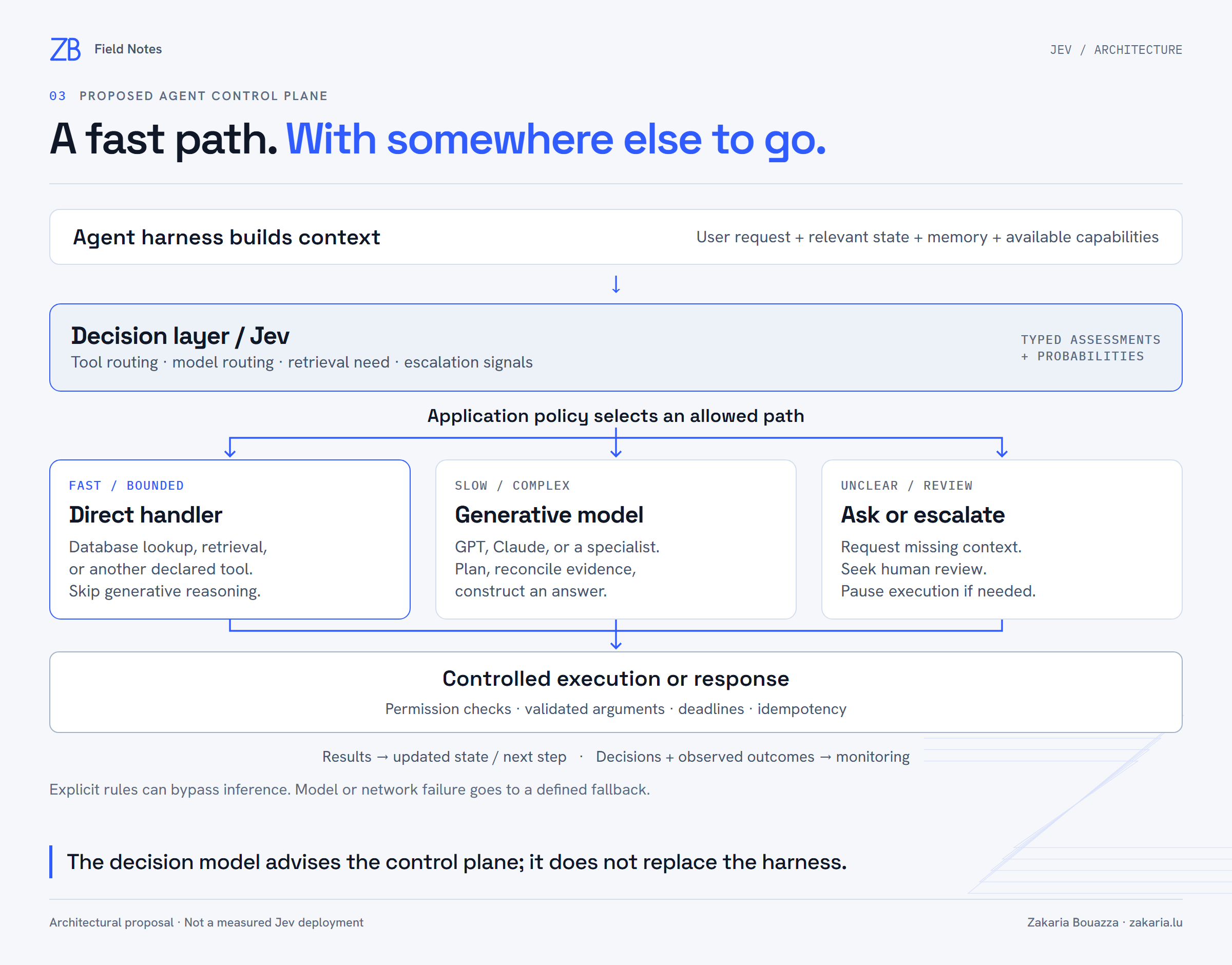
Consider “Where is order A-104?” The authenticated application already knows the user and order identifier. A bounded semantic decision may route this to a read-only lookup. Code verifies ownership, calls a parameterized API and formats the result. A generative model need not decide the same route, invent a query and write an explanation at every step.
Now consider “These delivery records disagree; reconcile the timeline and draft a response.” That request may justify retrieval, several tools and a generative reasoning model. A proposed fast path should preserve that slow path.
Known cases can bypass inference entirely. An explicit API operation or an unambiguous application rule does not need a model's opinion. For the remaining cases, I would expose small decisions such as:
| Agent decision | Model's contribution | Runtime's responsibility |
|---|---|---|
| Which tool or data source? | Route among declared capabilities; assess whether RAG is useful. | Enforce access, build arguments, perform database or retrieval calls. |
| Which specialist or model? | Classify intent and assess the need for deeper reasoning. | Choose an allowed backend within budget and deadline. |
| Clarify or escalate? | Assess missing information and ambiguous intent. | Ask the user or create a human-review task. |
| Is this risky? | Provide a semantic risk signal. | Apply mandatory controls independently of the prediction. |
| Retry or stop? | Assess whether an outcome satisfies the task. | Classify transport errors, cap retries and enforce idempotency. |
Not every one of these decisions requires autoregressive generation. But neither should every one become an AI decision: a timeout retry policy is usually code, and authorization is always a system responsibility.
The policy is more than “take the largest number”
Suppose a validated routing distribution favors a database lookup. I would still require complete arguments, an available read-only handler, sufficient remaining time and permission to access the record.
This is application pseudocode, not Jev SDK syntax. The threshold is illustrative and would need validation:
def choose_path(context, prediction):
    if context.requires_human_approval:
        return HUMAN_REVIEW
    if not prediction.valid:
        return SAFE_FALLBACK
    if context.missing_required_fields:
        return ASK_USER
    if (
        prediction.probabilities["query_database"] >= 0.95
        and context.lookup_is_read_only
        and context.lookup_is_available
        and context.lookup_is_authorized
    ):
        return DATABASE_LOOKUP
    return REASONING_MODEL
A 0.91 prediction from the earlier illustration would not pass that 0.95 gate. That is intentional: ranking alternatives and authorizing automatic execution are separate decisions.
I would give the executor a closed set of handlers, validate arguments independently and recheck permissions at execution. A type-safe route can still be semantically wrong, and the state can become stale between assessment and action. Type safety cannot make an irreversible action safe by itself.
Parallel questions are useful for independent assessments of the current state. They do not supply a joint probability distribution for an entire plan. I would not multiply their probabilities to claim a workflow success rate without justified assumptions about dependence.
A fast path has to earn its place
The System 1 / System 2 comparison is useful as an architectural analogy: a quick bounded assessment, with more expensive reasoning available when needed. It is not a claim that either model reproduces human cognition.
Model cascades are also not new; FrugalGPT explored routing across LLMs before Jev. The question is whether a decision-specific model improves the practical trade-off for this workload. FrugalGPT.
For a simplified sequential design, let D be decision-layer latency, G generative-model latency and q the fraction escalated to that model:
Mean model latency ≈ D + q × G
Mean model cost    ≈ C_decision + q × C_generation
With invented values of D = 0.15 s, G = 4 s and q = 0.20, the mean model latency would be 0.95 s. These are arithmetic examples, not Jev measurements. They omit context assembly, tools, retries and different workloads on the two paths.
When nearly everything escalates, the router adds a hop. The slow requests still pay for both models, so lower mean latency does not guarantee a better p95. A cheap incorrect route can also become expensive through retries or human repair. I would compare cost per successfully completed task at an acceptable error rate.
The same uncertainty has different consequences across actions. A low-risk read can tolerate a policy that would be unacceptable for issuing a refund. Thresholds should follow validated outcomes and error costs, not one global “confidence” constant.
What I would measure before trusting the fast path
I would start with a narrow read-only workload: support routing, selecting a retrieval source or choosing a document-processing queue. Those have bounded alternatives and outcomes that can be reviewed.
First, collect representative examples with an explicit definition of the correct route, including “none fits” and ambiguous cases. Compare deterministic rules, a conventional classifier where appropriate, a small LLM, Jev and the existing generative path. Keep the harness and quality target comparable.
Then run the proposed layer in shadow mode. Log the model version, question/schema version, policy version, returned distribution, selected branch, latency and eventual outcome, with sensitive context redacted. Track calibration by probability bucket and task segment alongside automation coverage, error severity, escalation rate and cost.
A high-confidence error should be visible. A model can look calibrated in aggregate while a particular language or customer segment behaves badly. Dataset shift also weakens uncertainty estimates; evaluation must continue as traffic changes. Research on predictive uncertainty under dataset shift.
Versioning matters operationally: TypeSafe documents that jev-latest can move. Pin a version for an evaluated policy, record the responding version, and revalidate thresholds before upgrading. Model aliases and versioning. Circuit breakers, a total retry budget and a defined fallback belong around the API just as they would around any other remote dependency.
The boundaries are part of the design
Jev does not offer open-ended text generation, so it cannot fill the role of a model that writes a novel explanation, arbitrary SQL or a new program. A bounded selector can choose a provided candidate; that does not make it an unrestricted extraction engine.
TypeSafe's Jev 1.13 limitations page, reviewed on 16 September, flags counting and numerical precision, date comparisons, indirection, irrelevant context and adversarial content. It explicitly acknowledges that injected instructions or misleading material can steer answers. The same page advises keeping arithmetic in code and using generative models for generation. Jev's documented failure modes.
The state documentation currently specifies text inputs, including structured JSON, rather than direct image, audio or video understanding. Supported state formats. These constraints matter more to a design review than a speed multiplier.
I would also ask for evidence about calibration on my domain, accuracy under missing context, availability, throughput and the behavior of version upgrades. A concentrated distribution cannot reveal an alternative the application forgot to include.
Closed output sets constrain what can be returned. They do not eliminate wrong judgments. That is the distinction I would preserve whenever discussing claims about eliminating hallucinations.
Intelligence as composable infrastructure
The possibility that interests me is a system assembled from components with different responsibilities: decision models for bounded judgments, generative models for reasoning and communication, embedding and retrieval models for finding context, tools for acting, memory for carrying state, and deterministic software for enforcing the rules.
An agent harness would coordinate those components. It could test a decision policy independently of a prose-generation prompt, change the reasoning model without changing the executor, and attribute failures to a particular boundary.
That adds contracts, latency budgets and operational work. The benefit has to justify the complexity. But it is a recognizable software architecture, with intelligence placed where the application needs it.
I do not need Jev to replace generative LLMs for that idea to be useful. I need a decision primitive that is accurate enough, measurable enough and cheap enough to compose with them. Whether Jev meets that bar is still a question to test. The architectural question is already worth asking.