Decision models in llama.cpp: asking a 4B model to choose instead of talk
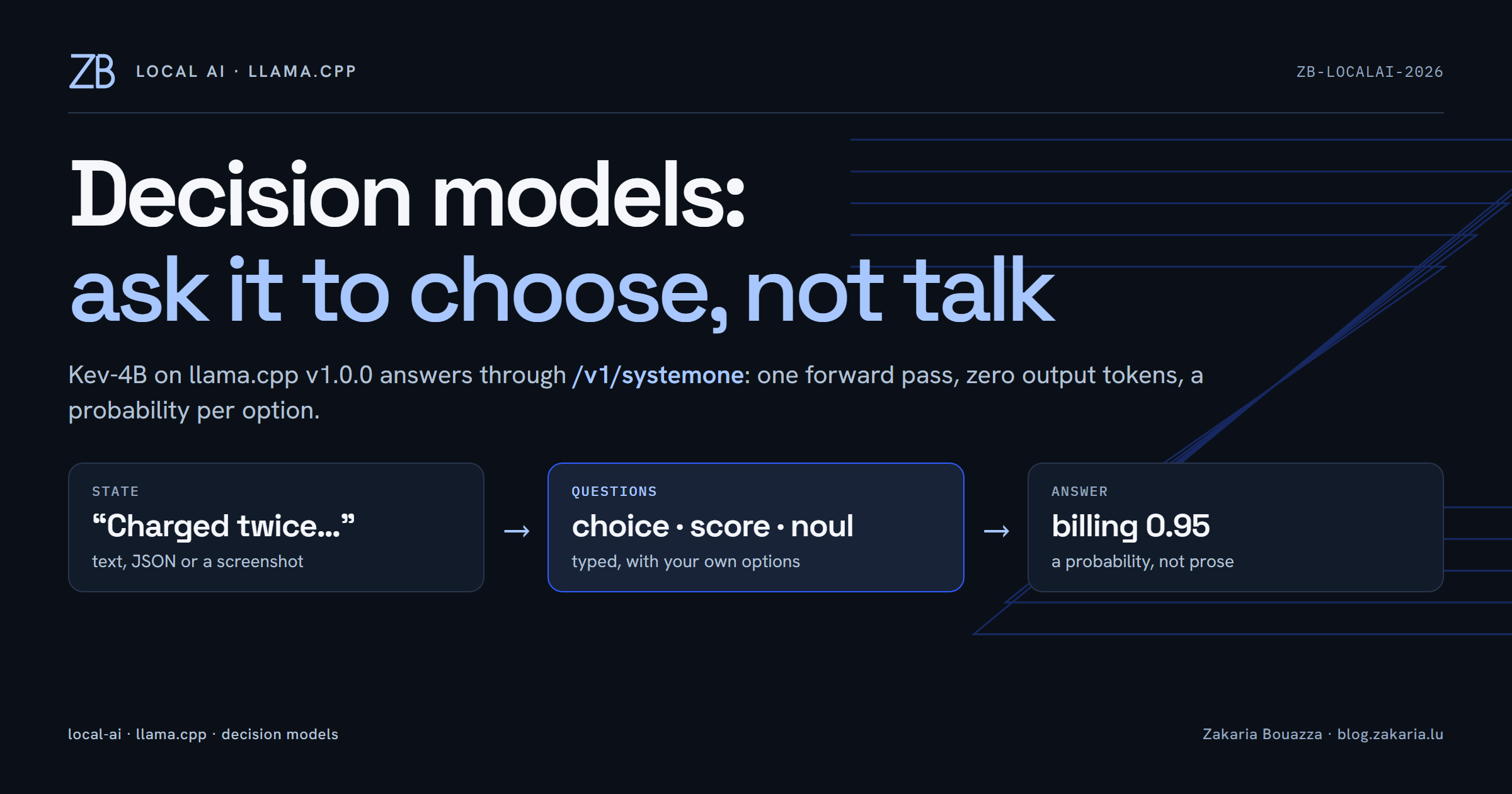
This morning I wiped every local model on my workstation and reinstalled llama.cpp from scratch, because v1.0.0 had just shipped. The machine is an AMD Strix Halo laptop: a Radeon 8060S iGPU sharing 96 GB of LPDDR5X with the CPU. Qwen3.8-27B at Q4 generated 11.6 tokens per second on it, and about 23 on a code prompt once I turned on MTP speculative decoding. That is usable, but every token still has to stream the whole model through memory.
Then I read the ggml-org post New in llama.cpp: Decision Models, and it describes a different contract entirely: the model does not write anything. You give it a state and typed questions, and it returns a probability for each option you offered. I tried it with Kev-4B the same afternoon. This post covers what the three question types are, how to read their fields, and what I measured.
What a decision model is
A decision model answers by scoring options you supply instead of generating text. The server exposes it at POST /v1/systemone, which follows the TypeSafe System One format. The answer is always one of your options, with a probability attached, and usage.output_tokens is always zero. The typical uses are routing a request, moderating content, checking that an agent's step worked, or choosing an agent's next action.
You cannot point it at an ordinary chat model. It needs weights trained for the task. The supported list in the post goes from Julia-1 (144M, mmBERT-small) up to OpenJev and Clef (27B, both based on Qwen3.8-27B). I picked Kev-4B: Apache 2.0, built on Qwen3.5-4B-Base, and small enough that the 4.5 GB Q8_0 file is an easy choice. Probabilities are the whole output, so I would rather not quantize them away.
Running Kev-4B
& 'C:\Users\Zakaria\llama\llama-server.exe' -hf ggml-org/Kev-4B-GGUF:Q8_0 -ngl 99 -fa on -c 8192 -ub 1024 --port 8081There are no sampling flags because nothing is sampled. The startup log says what changed under the hood: decision model reads the embeddings output, enabling embedding mode, then decision model type: kev, and one line worth remembering: decision model: prompt cache disabled by default, use --cache-ram N to enable it. The server docs confirm it: --cache-ram defaults to 8192 MiB, but to 0 for decision models.
The three question types
A request is a state (a string, an object, an array, or chat messages with images on models that read them) plus a questions object that maps your own ids to typed questions. This is the request from the post, which I sent unchanged:
{
  "state": "Customer message: I was charged twice for my order last week and nobody has replied.",
  "questions": {
    "route": {
      "type": "choice",
      "instructions": "Which team should handle this?",
      "criteria": {
        "billing": "payments, charges, refunds, invoices",
        "shipping": "delivery, tracking, lost or late parcels",
        "technical": "bugs, errors, login problems"
      }
    },
    "angry":   { "type": "noul",  "instructions": "Is the customer angry?" },
    "urgency": { "type": "score", "instructions": "How urgent is this?",
                 "criteria": ["can wait", "this week", "today", "right now"] }
  }
}
And this is what came back (the full JSON, trimmed to the answers):
"route":   { "type": "choice", "choice": "billing",
             "probabilities": { "billing": 0.9466, "technical": 0.0409, "shipping": 0.0125 },
             "confidence": 0.9199 },
"angry":   { "type": "noul", "noul": 0.8279 },
"urgency": { "type": "score", "score": 2.2879,
             "legend": { "0": "can wait", "1": "this week", "2": "today", "3": "right now" },
             "probabilities": { "0": 0.0417, "1": 0.1893, "2": 0.2084, "3": 0.5606 },
             "confidence": 0.2879 }
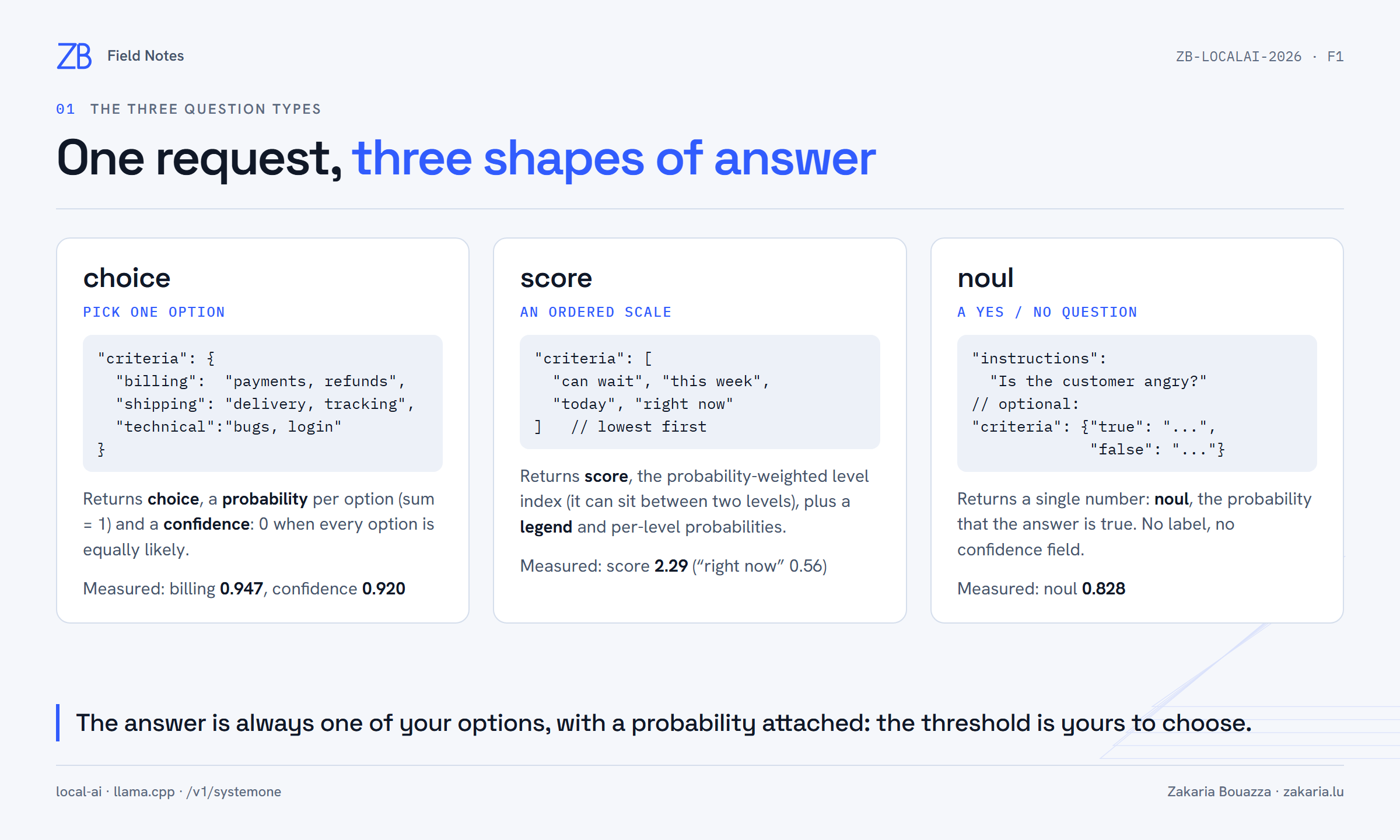
choice: pick one option
criteria is an object that maps each option to a description, which may be null. The answer has choice (the most likely option), probabilities (one per option, summing to 1) and confidence. The docs define confidence only loosely: 0 to 1, where 0 means all options are equally likely. On my runs it matched (ptop − 1/n) / (1 − 1/n) exactly: (0.9466 − 1/3) / (2/3) = 0.9199. So it is the top probability rescaled so that a uniform guess scores 0. A two-option question at 0.75 gives a confidence of 0.5, not 0.75. Keep that in mind when you pick a cutoff.
score: a position on an ordered scale
criteria is an array of 2 to 10 levels, lowest first. The answer is score, the probability-weighted level index, so it can fall between two levels: 2.29 means "between today and right now, leaning right now". You also get a legend that maps indices back to your labels, the per-level probabilities, and a confidence the docs define only as a value from 0 to 1. One gotcha from PowerShell: build the levels as an array (@(...)), never a hashtable, or you can lose the order that gives the answer its meaning.
noul: a yes/no probability
noul is the yes/no question type. The answer is a single number, also called noul: the probability that the answer is true. There is no label and no confidence field, because the number already is the decision. Criteria are optional. When you supply them, they describe what true and false mean:
"angry": {
  "type": "noul",
  "instructions": "Is the customer angry?",
  "criteria": { "true": "frustrated, upset, or hostile tone",
                "false": "calm or neutral tone" }
}
With those descriptions, "Is the customer angry?" went from 0.828 to 0.835 for the double-charge message. That is no real change here, but descriptions do matter for choice questions, as the next section shows.
What I measured
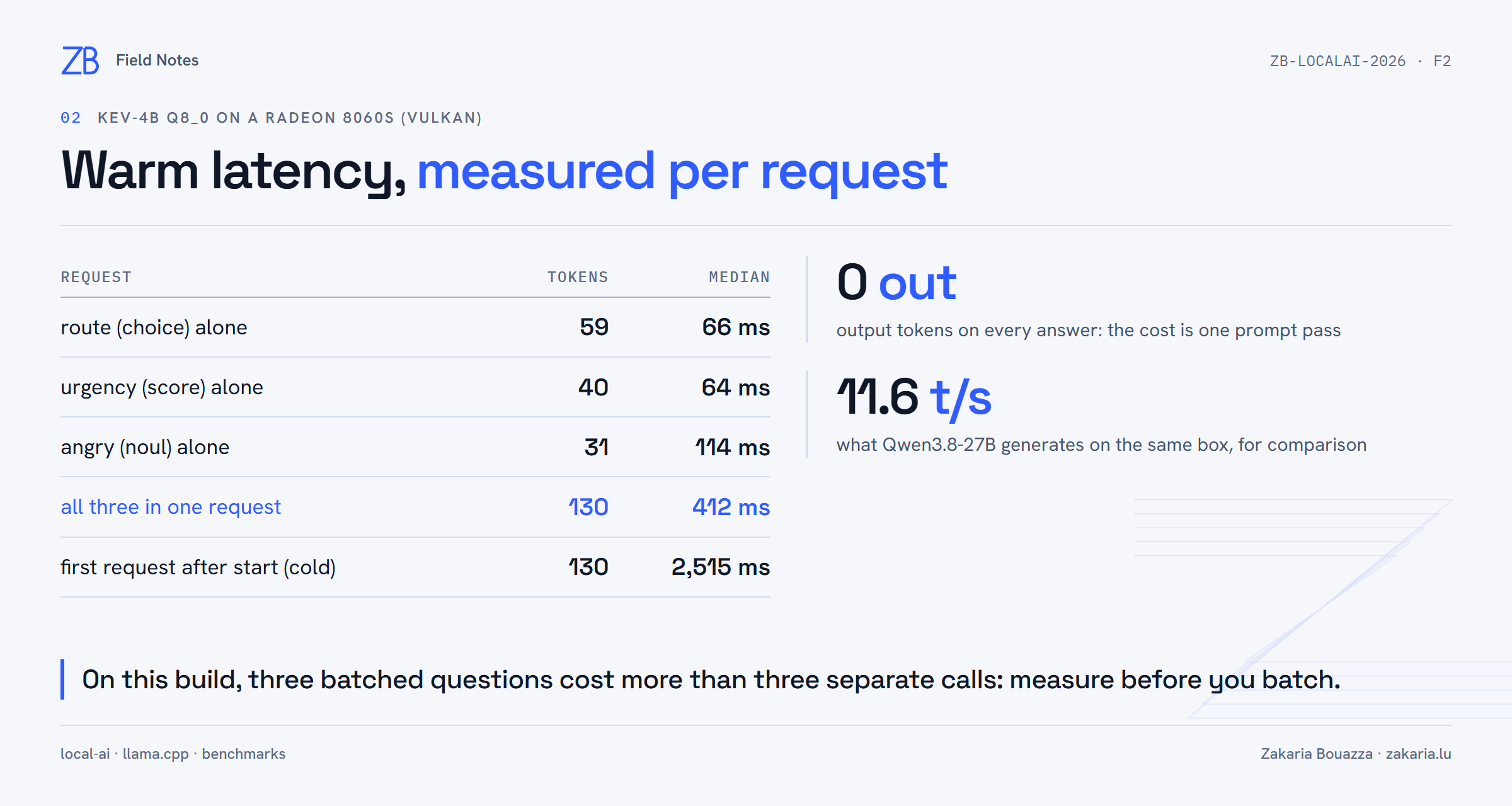
The first request took 2.5 seconds, mostly one-off warm-up. After that, a single question took roughly 65–115 ms over Vulkan on an iGPU. That is the point of the format: each answer costs one pass over a prompt of a few dozen tokens, which is the cheap direction on my hardware.
The surprise was batching. The post recommends batching questions because Kev-4B processes the state only once. On my build, three questions in one request took a median 412 ms, while the same three as separate calls added up to about 244 ms. I have not tracked down why. With the prompt cache off by default, I would test --cache-ram next before deciding how to group questions. For now, my rule is to measure batching rather than assume it helps.
Where the probabilities were honest, and where they weren't
- Bare labels still worked. With the option descriptions set to
null, "charged twice" still went to billing, but at 0.873 instead of 0.947 (confidence 0.81 instead of 0.92). The post shows Julia-1 misrouting the same message with bare labels, so descriptions matter more on smaller models. They help everywhere. - Vague input produced low confidence. "Hi, quick question about my account" went to technical at 0.61 with a confidence of 0.41, and the urgency confidence fell to 0. That is the behaviour you want: the low number is the signal to hand the message to a human.
- Score was the weakest. "Thanks, the parcel arrived this morning, all good!" routed to shipping at 0.93 and was correctly not angry (noul 0.0045), but the urgency peak was "today" at 0.54. A thank-you message is not urgent. Treat the score type with suspicion until you have checked it on your own examples.
Why this fits a machine like mine
A dense model on unified memory is limited by bandwidth when it generates: every new token reads every weight. A decision skips that phase completely. It is prefill only, which is compute-bound and runs in batches, and that is where the 8060S is comparatively strong. A 4B model answering a routing question in about 65 ms on a laptop iGPU is fast enough to sit in front of a slower generator. One sensible pattern: let Kev-4B decide whether a request needs the 27B at all, and only then pay 11 tokens per second for prose.
What I would build on it first is a gate: confident answers act automatically, low-confidence ones go to a person. The threshold depends on the model, which the post says too, and my vague-message test showed how differently the numbers move. Choose the cutoff from your own examples, not from the defaults.